
Quick answer
The marketing funnel has five stages: Awareness, Consideration, Conversion, Retention and Advocacy. It maps the journey from first touch to repeat purchase and referral, and each stage needs different content, channels and KPIs. Marketers group them as TOFU (top of funnel), MOFU (middle) and BOFU (bottom).
01 · Foundations
What is a marketing funnel?
A marketing funnel is a model of the customer journey that narrows a large audience of strangers into a small group of buyers — and ideally, promoters. At each stage some people drop out, which is why the shape is a funnel: many enter at the top, few convert at the bottom.
The funnel is useful for one simple reason: different questions dominate at different stages. A stranger asks “do I have this problem?”; a prospect asks “why you?”; a customer asks “did I choose well?”. Strategy is the discipline of answering the right question at the right time — with the right channel, asset and metric attached.
Modern funnels are not linear pipes but loops: retention and advocacy feed new awareness, compounding growth. That is why this guide treats post-purchase as a stage, not an afterthought.
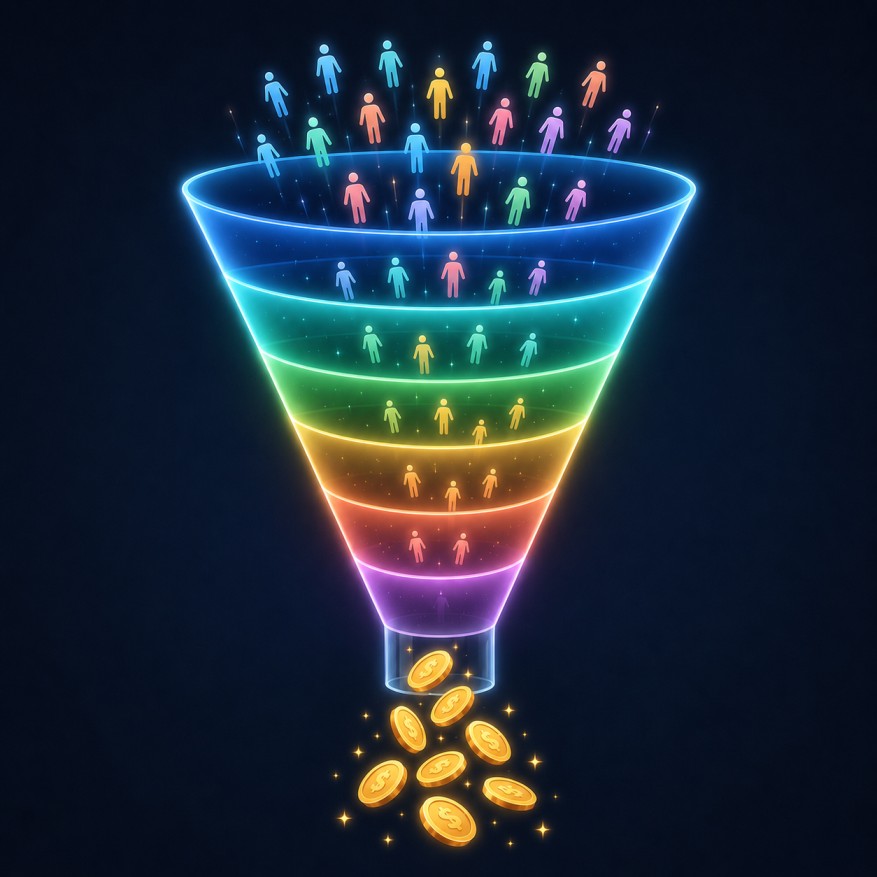
How TOFU, MOFU and BOFU map to the funnel
Awareness
Problem-education and reach. You are competing for attention, not selling yet. Content teaches; ads introduce; PR borrows trust.
Consideration
Capture and nurture. Exchange value for contact details, then earn the next open, click and call with education that shortlists you.
Conversion
Proof and de-risking. Trials, demos, case studies, reviews and guarantees that turn “interested” into “invoice paid”.
02 · The journey
The 5 funnel stages, explained
Scroll through the stack — each card is one stage, with the buyer’s question, the goal, the KPIs that tell the truth, and the tactics that move the number. Cards pin as you scroll, exactly like prospects pin themselves to one stage until you answer their question.
Awareness
TOFUBuyer asks: “What is this problem — and who even talks about it?”
Winning tactics
- SEO pillar content & problem-education blogs
- Short-form video & podcasts
- PR, data studies & founder-led social
- Broad paid social prospecting
Formats that work
- “What is / why it happens” explainers
- Industry benchmark reports
- Reels, shorts & carousels
- Guest appearances & newsletters
Consideration
MOFUBuyer asks: “What are my options — and who understands my problem?”
Winning tactics
- Lead magnets & gated frameworks
- Email nurture sequences
- Webinars & live teardowns
- Retargeting with education, not banners
Formats that work
- Templates, checklists, calculators
- Comparison & alternatives content
- Buyer’s guides
- Product-led mini courses
Conversion
BOFUBuyer asks: “Why you — and is the risk worth it?”
Winning tactics
- Demos, trials & self-serve onboarding
- Case studies with hard numbers
- Reviews, G2/Trustpilot & social proof
- Landing-page CRO & offer testing
Formats that work
- ROI calculators & pricing pages
- “Vs” pages & migration guides
- Guarantees & security docs
- Live Q&A & sales enablement
Retention
POST-SALECustomer asks: “Did I make the right choice?”
Winning tactics
- Onboarding that reaches first value fast
- Lifecycle & usage-triggered email
- Customer education & certifications
- Proactive support & success calls
Formats that work
- Activation checklists
- Feature-adoption campaigns
- Loyalty & upgrade paths
- Community & office hours
Advocacy
LOOPCustomer asks: “Who else should hear about this?”
Winning tactics
- Referral programs with real incentives
- Review & testimonial asks at peak joy
- Case-study co-marketing
- Ambassador & community programs
Formats that work
- Shareable wins & badges
- UGC campaigns & templates
- Customer advisory boards
- Partner & affiliate kits
03 · Playbook
Funnel strategy: what to run at each stage
Strategy is allocation: attention-budget at the top, trust-budget in the middle, proof-budget at the bottom. Here is a compact operating playbook per band, followed by the post-sale engine that turns customers into a channel.
Create & capture demand
Objective: be the first name recalled when the problem gets a name.
- Own 3–5 problem keywords with pillar pages
- Publish one original data point per quarter
- Run short-video sprints, retarget engagers
- Build newsletter & podcast distribution
- Measure recall: branded search trend
Earn the shortlist
Objective: exchange value for identity, then nurture to readiness.
- One flagship lead magnet per persona
- 5–7 touch nurture stream, behaviour-based
- Webinar → replay → follow-up cadence
- Comparison content for active evaluators
- Score leads on fit + engagement
De-risk the decision
Objective: remove the last objection before the competitor does.
- Case studies matched to industry & size
- Trial/demo flow with time-to-value SLA
- Review-site presence & “vs” pages
- Guarantee, migration & security assets
- CRO program: one test per week
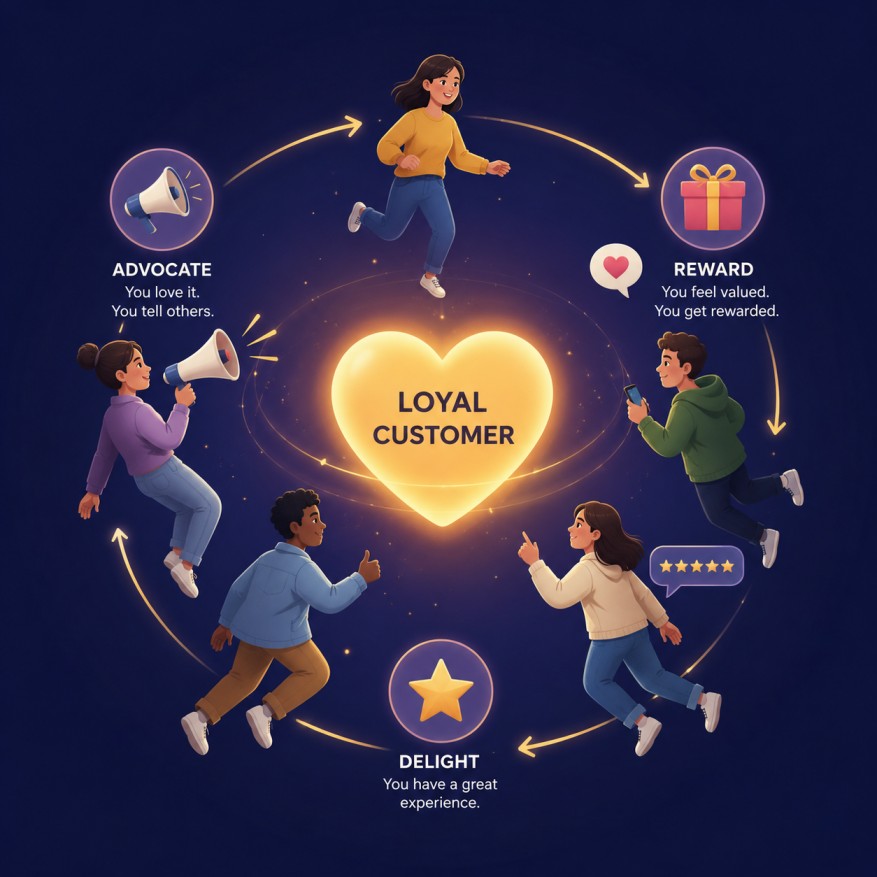
Stages 04–05 · The loop
The post-sale engine
Retention and advocacy are strategy, not support tickets. Wire these four triggers and the funnel becomes a flywheel:
- Day 0–14 onboarding sprint — drive to the first “aha” metric; activation predicts retention.
- Usage-triggered lifecycle email — celebrate wins, rescue stalls, surface the next feature.
- NPS gate at day 30/90 — promoters get a referral ask; detractors get a human call.
- Referral & review incentives — make sharing a two-click, two-sided reward.
Channel emphasis by stage
Relative emphasis (0–10) a balanced B2B team places on each channel, per stage.
| Stage | SEO & Content | Paid Social | Email & Nurture | Retargeting | CRO & Landing | Referral & Community |
|---|---|---|---|---|---|---|
| Awareness | 9 | 8 | 4 | 2 | 3 | 4 |
| Consideration | 8 | 5 | 8 | 7 | 5 | 5 |
| Conversion | 4 | 5 | 7 | 9 | 10 | 5 |
| Retention & Advocacy | 3 | 2 | 10 | 4 | 5 | 9 |
Emphasis scale 0–10. Values are directional planning heuristics.
Where budget typically goes
A common starting allocation — shift toward your constraint (see leaks).
04 · Measurement
The numbers: benchmarks & your funnel math
You can’t optimise what you don’t measure per stage. Start with these directional benchmarks, then replace them with your own stage-to-stage rates — the calculator below shows how the math compounds.
Stage-to-stage conversion benchmarks
Directional B2B SaaS example. Your market differs — the habit of measuring each hand-off matters more than the number.
Percentage of each stage that carries forward to the next. Directional B2B SaaS example.
Funnel calculator — model your month
Drag the sliders. Outputs update live: volume at each stage plus projected monthly revenue.
Bar width = conversion from the previous stage. Improving the worst hand-off always beats improving the best one.
05 · Models
Funnel frameworks, compared
Pick one primary model and map everything else onto it. Switching frameworks quarterly is a classic way to never learn anything.
| Framework | Stages | Best for | Watch out |
|---|---|---|---|
| AIDA | Attention → Interest → Desire → Action | Creative & message design — one ad, one page, one email | Silent after the purchase |
| TOFU / MOFU / BOFU | Top → Middle → Bottom of funnel | Content & media planning across the buyer journey | Can oversimplify retention |
| See–Think–Do–Care | Audiences by intent, plus post-sale care | Full-funnel measurement & audience strategy | Needs data maturity |
| AARRR | Acquisition → Activation → Retention → Revenue → Referral | Product-led & SaaS growth teams | Skews to product metrics |
06 · Optimisation
5 common funnel leaks (& fixes)
Find the biggest stage-to-stage drop, fix that one leak, repeat. Optimising everywhere at once is how budgets disappear.
Traffic but no leads
Content attracts browsers; the offer never matches the intent that arrived.
Fix: align one lead magnet per top page to the page’s exact question.
Leads but no MQLs
A mailing list, not a pipeline. No scoring, no nurture, no next step.
Fix: behaviour-based nurture stream + a simple fit/engagement score.
MQLs but no closes
Marketing and sales disagree on what “qualified” means; follow-up stalls.
Fix: shared definition, SLA on response time, BOFU proof assets.
Customers but churn
Sold on promise, onboarded into silence. First value arrives too late.
Fix: activation milestones in days 0–14 with usage-triggered emails.
Loyalty never asked
Happy customers exist, but no referral, review or case-study trigger fires.
Fix: NPS gate — promoters get an ask within 48h of a high score.
07 · Questions
Marketing funnel stages and strategy FAQs
What are the 5 stages of the marketing funnel?
The five stages are Awareness (discovery), Consideration (evaluation), Conversion (purchase), Retention (repeat usage) and Advocacy (referral). Marketers commonly group them as TOFU, MOFU and BOFU for planning content and media.
What do TOFU, MOFU and BOFU mean?
TOFU (top of funnel) is awareness content that educates the problem. MOFU (middle) is consideration content that captures and nurtures leads. BOFU (bottom) is conversion content — demos, trials, case studies, pricing — that de-risks the decision.
What is a good funnel conversion rate?
Directional B2B benchmarks: visitor→lead around 2–4%, lead→MQL around 15–30%, MQL→SQL around 35–50%, opportunity→win around 20–30%. Industry variance is huge, so the real win is tracking your own stage-to-stage rates monthly.
How is a marketing funnel different from a sales funnel?
The marketing funnel covers demand creation from first touch to handoff; the sales funnel covers pipeline from qualified lead to closed deal. They overlap at the conversion stage, which is why a shared MQL/SQL definition matters.
How do I find leaks in my funnel?
Measure each stage-to-stage conversion, rank the drop-offs, and run one experiment at a time on the worst hand-off — e.g. a matched lead magnet for visitor→lead, or a nurture stream for lead→MQL. Re-measure after each test.
Which metrics matter at each stage?
Awareness: reach, new visitors, branded search. Consideration: lead rate, engagement, subscribers. Conversion: conversion rate, CAC, win rate. Retention: churn, LTV, NPS. Advocacy: referral rate, reviews, promoters. One north-star metric per stage keeps teams honest.
08 · Key Takeaways
Key takeaways
If you remember six things from this guide, make it these:
- Five stages: Awareness → Consideration → Conversion → Retention → Advocacy; plan TOFU/MOFU/BOFU plus post-sale.
- One question per stage: answer the buyer’s current question, not your quarterly target.
- One north-star metric per stage — reach, lead rate, conversion rate, churn, referral rate.
- Measure every hand-off; fix the single biggest leak before touching anything else.
- Retention is acquisition: onboarding and lifecycle email are growth channels, not chores.
- Close the loop: ask promoters for referrals and reviews at peak joy — advocacy feeds awareness.