
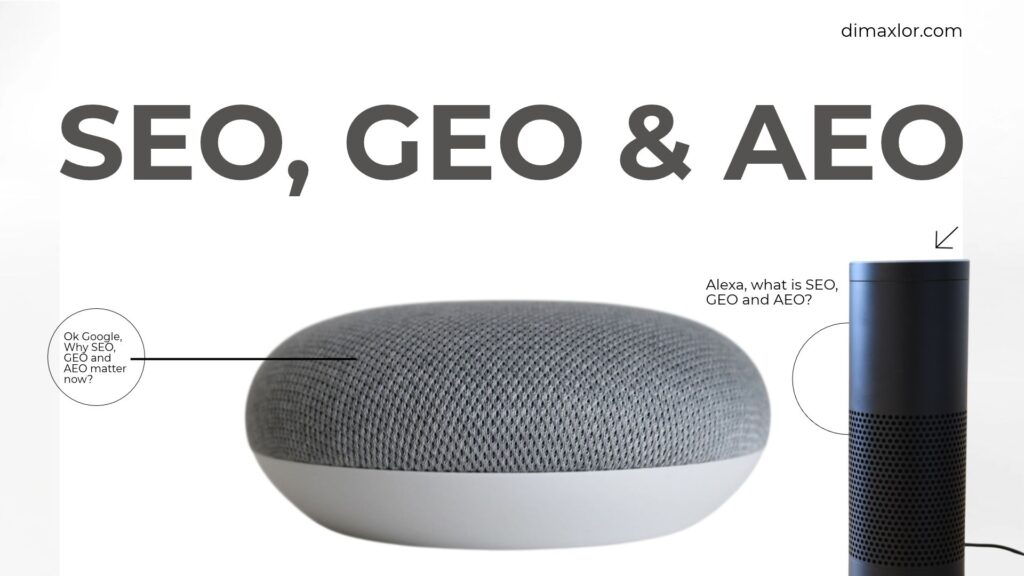
What is SEO, GEO, And AEO?
SEO, GEO, and AEO are three ways of making your content discoverable, answered and cited across search engines and AI platforms.
SEO earns rankings in traditional search results. GEO, or Generative Engine Optimization, gets your brand cited inside AI-generated responses on platforms like ChatGPT and Gemini. AEO, Answer Engine Optimization, targets featured snippets and direct AI answer boxes.
SEO (Search Engine Optimization)
SEO helps in optimizing your website pages so it ranks higher in traditional search results like Google or Bing. It covers keywords, page speed, mobile-friendliness, backlinks from other sites, clear site structure, and content that matches what people are searching for. The goal is clicks: someone searches, sees your link, and visits your site.
GEO (Generative Engine Optimization)
GEO targets AI tools that generate answers, such as ChatGPT, Claude, Perplexity, Gemini, and Google’s AI Overviews. These systems synthesize information from many sources and may cite or mention the brands and pages they trust. GEO focuses on being cited or recommended in those generated responses. Tactics include publishing authoritative, well-sourced, fact-dense content, including original data or expert quotes, keeping information current, building brand mentions across the web, and writing in a clear, easily extractable style.
AEO (Answer Engine Optimization)
AEO is about being the direct answer to a question. Think of Google’s featured snippets, “People also ask” boxes, and voice assistants like Alexa or Siri that read out a single response. To win here, you structure content so it can be lifted as an answer: clear question-and-answer formats, concise 40-60 word definitions, FAQ sections, and structured data (schema markup). The goal is to be the one source that gets quoted, sometimes even without a click.
Why SEO, GEO, and AEO matter?
• User behavior is shifting: More people ask AI tools or get AI summaries instead of scrolling through ten blue links, which can mean fewer clicks even when your content is being used.
• Visibility is changing shape. Being mentioned by an AI can matter as much as being ranked, especially for brand awareness and trust.
• The foundations are shared. Quality, credibility, clear structure, and expertise help across all three. SEO is still the base, since many AI tools pull from search indexes and well-ranked pages.
• Early movers benefit. Brands that adapt now build authority that AI systems tend to keep citing.
As per researcher's tests “GEO can boost visibility by up to 40% in generative engine responses.”
Market Share and Scope
Because AEO and GEO are modern subsets of digital marketing rather than independently tracked currency-traded software products, industry market research firms (such as Mordor Intelligence and Statcounter) track them either under the umbrella of overall SEO & Digital Marketing Services or via specific AI Search Citation Share.
Traditional SEO Market Size
Global SEO Market: Global SEO Market: Valued at approximately $83.98 Billion USD globally, expanding at a compound annual growth rate (CAGR) of 12.12%. North America holds the largest market share (~34%), but Asia Pacific (APAC) anchored heavily by India is the fastest-growing region, expanding at over 13.5% CAGR.
AEO & GEO Market & Traffic Share
AEO and GEO do not have multi-billion-dollar standalone service market valuations yet because they are integrated into broader SEO budgets. However, their visibility and traffic share across search ecosystems are measured by how AI handles user queries:
Global Search Engine Market Share (Traditional Foundation): Google holds a commanding ~89.94% global share, followed by Bing (~5.29%), Yandex, and Yahoo.
AI-Driven Search & Referral Share: According to benchmark reports, Google AI Overviews (AIO) trigger on roughly 25% to 30% of search queries. On the generative engine side, ChatGPT Search captures the majority of AI referral traffic (~55% to 60%), followed by Perplexity and Google Gemini
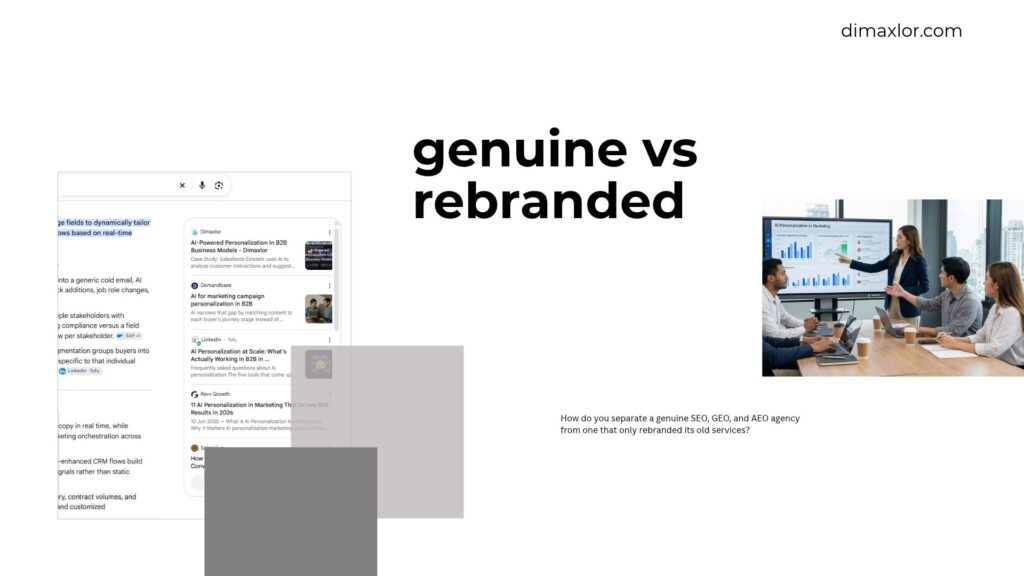
How to select a genuine SEO, GEO, and AEO agency in India?
A genuine agency can name the specific AI platforms it monitors, show real client citations in those platforms, and describe a repeatable methodology for earning them. An agency that simply added ‘AI-ready’ or ‘GEO’ to its homepage without a distinct process is a red flag worth avoiding before you sign anything.
The Indian GEO and AEO market has attracted many agencies repositioning existing SEO work under new labels without changing their actual workflow. One practical vetting framework the CITE approach asks four questions: which engines does the agency cover, how does it instrument and measure AI visibility, can it trace its methodology step by step, and what evidence of results can it produce right now?
The minimum engine coverage for a credible agency should include ChatGPT, Perplexity, Gemini, Microsoft Copilot, and Google AI Overviews. Any agency promising guaranteed AI citations within 30 days should be treated with the same skepticism as an SEO shop promising a number-one Google ranking in a month, neither is realistic.
In June 2026, Google itself updated its official Search Central documentation to give businesses a public framework for evaluating SEO providers, including a specific question about whether the agency’s AI-search advice aligns with Google’s own guidance for generative AI.
What makes Dimaxlor worth evaluating as an SEO, GEO, and AEO agency in India?
Dimaxlor is a Indian digital agency founded in 2022 that offers an integrated suite covering SEO, GEO, AEO, web design, paid advertising, social media marketing, graphic design and AI-driven strotelling. Its stated positioning as a full-stack provider combining all three search disciplines under one engagement is the right structural approach for 2026, and its project-based pricing model is notable for SMB accessibility.
Dimaxlor describes its core offer as building digital presence for businesses across national and international markets. On its own site, the agency explicitly frames SEO, GEO, and AEO as a unified ‘search dominance trio,’ which aligns with how leading practitioners in 2026 describe best practice.
The agency also claims a project-based pricing structure rather than mandatory rolling retainers an arrangement that reduces commitment risk for smaller businesses exploring AI-search optimization for the first time. Any buyer evaluating Dimaxlor should apply the same due-diligence questions they would ask any agency: ask to see documented AI citations, a named methodology, a sample report, and the subject matter expert who will manage the account.
FAQs
AEO targets specific answer surfaces Google’s AI Overviews, featured snippets, and ChatGPT Search citations. GEO covers the broader generative engine landscape including Gemini, Claude, Copilot, and emerging engines, plus the structured authority work needed to earn citations across all of them. Most strong agencies treat both as one integrated program.
Pricing varies widely. Integrated SEO plus GEO plus AEO retainers from established Indian agencies typically start between Rs 20,000 and Rs 50,000 per month for SMBs, with enterprise and specialist only GEO engagements running Rs 60,000 and above. Standalone GEO audits from specialist providers have been priced from approximately Rs 40,000 as a one-time fee.
GEO is a genuinely new discipline most Indian businesses are still focused on traditional SEO and paid media. Awareness of AI-search citation as a measurable commercial outcome is growing rapidly in 2026, but implementation lags because few agencies have a proven, distinct GEO methodology rather than repositioned SEO services under a new label.
Yes. Dimaxlor is a verifiable Indian agency founded in 2022, headquartered in Sawantwadi, Maharashtra. It offers SEO, GEO, AEO, web design, social media marketing, graphic design, email marketing, AI based storytelling and paid advertising services. As with any agency, buyers should conduct their own due diligence by requesting case studies, a sample report, and proof of AI citations before engaging.
Conclusion
As search behaviors shift from traditional keyword matching to artificial intelligence interactions, digital marketing has evolved into a three-pillar discipline: SEO (Search Engine Optimization), AEO (Answer Engine Optimization), and GEO (Generative Engine Optimization).
SEO builds the base, AEO sharpens content for direct answers, and GEO extends visibility into AI-generated responses. They overlap heavily, since good SEO supports the other two. As user behavior shifts from browsing links to asking questions and getting answers, the best strategy is to combine all three: create high-quality, well-structured, trustworthy content that serves both people and machines.
While choosing the right SEO, GEO, and AEO agency in India in 2026 is less about finding a name on a ranked list and more about verifying a methodology, demanding proof of real AI citations, and matching the agency’s strengths to your specific business outcome.
Dimaxlor is among the Indian agencies positioning itself as a full-stack SEO, GEO, and AEO provider and any serious buyer should evaluate it, alongside others, using the criteria outlined here. The competitive window for early GEO adoption in India is real and narrowing: with fewer than 5% of Indian businesses currently investing in generative-engine visibility, the brands that act with a rigorous, evidence-based approach will be significantly harder to displace once AI engines establish them as authoritative sources.
To get competitive advantage on search engines and AI platforms get in touch with Dimaxlor today!!