
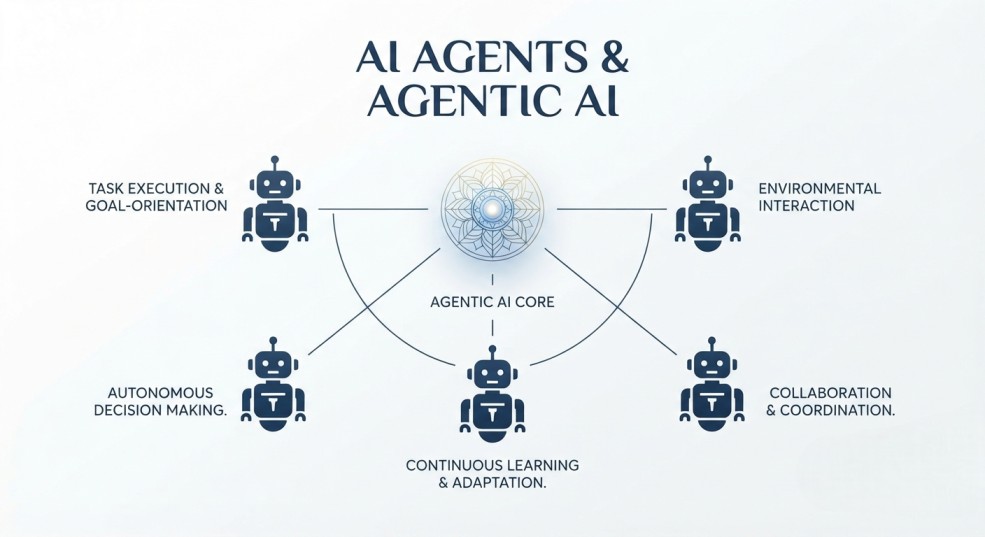
What are AI Agents and Agentic AI?
Artificial Intelligence is rapidly evolving, with AI Agents and Agentic AI representing two powerful approaches to intelligent automation.
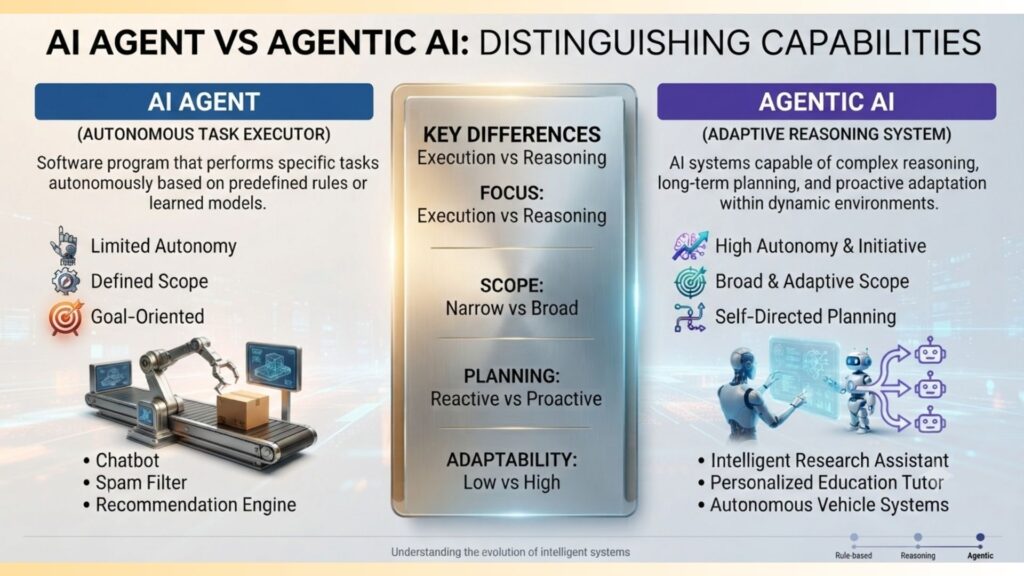
AI Agents are designed to execute specific tasks efficiently based on defined instructions.
Agentic AI goes beyond execution by planning, reasoning, adapting, and pursuing broader goals with greater autonomy.
Understanding both helps you choose the right approach for the right problem. The future of AI isn’t about picking one over the other, it’s about knowing when each delivers the most value.
How big is the agentic market right now?
As of mid-2026, multiple analyst firms place the global agentic AI market between roughly $9 and $10 billion, up from approximately $7 billion in 2025. Forecasts converge on a compound annual growth rate above 40 percent, though projections for 2031 and beyond vary widely between research firms depending on how they define the category.
Mordor Intelligence estimates the market at $9.89 billion in 2026, growing to $57 billion by 2031 at a 42 percent CAGR, while Fortune Business Insights projects a longer arc reaching $139 billion by 2034. Gartner, meanwhile, frames the opportunity differently, forecasting that agentic AI could account for roughly 30 percent of enterprise application software revenue by 2035. What every credible forecast agrees on is the direction: this is one of the fastest-growing segments in the entire technology sector, driven by breakthroughs in large-language-model reasoning, the maturation of multi-agent orchestration frameworks, and mounting enterprise pressure to automate complex, exception-heavy work. Source: Hostinger
Where are AI Agents actually delivering results?
Customer service, finance operations, software development, and security monitoring are the four areas showing the clearest, most-documented returns in 2026. In each case, the common thread is a high-volume, well-defined process where agent performance can be objectively measured against a human baseline.
Customer service agents handling refunds, escalations, and omnichannel support are saving small teams more than 40 hours a month, while finance automation is accelerating close processes by 30 to 50 percent. The Klarna AI assistant is a widely cited benchmark: built in partnership with OpenAI, it handled 2.3 million customer conversations in its first month, cut average resolution time from 11 minutes to under 2, and was credited with roughly $40 million in annual benefit. Across industries, compiled 2026 survey data reports an average 171 percent return on agentic deployments, with 74 percent of executives reporting positive ROI within the first year. Source: eCorpIT
Why do so many Agentic AI projects still fail?
Most agentic AI projects stall not because the technology is inadequate but because organizations deploy agents faster than they build the governance structures to manage them. Unclear business objectives, missing risk controls, and unchecked operating costs are the leading causes of project cancellation.
Gartner predicts that more than 40 percent of agentic AI projects launched in 2025–2026 will be canceled by 2027, largely due to unclear business value, escalating costs, and inadequate oversight. As of mid-2026, only about 23 percent of organizations report actively scaling an agent in production, while the majority remain in the experimentation phase. The gap is structural: enterprises are embedding agents into workflows without defining decision boundaries, without a central registry of what each agent is authorized to do, and without the audit logs needed to prove safe operation to regulators or internal stakeholders.
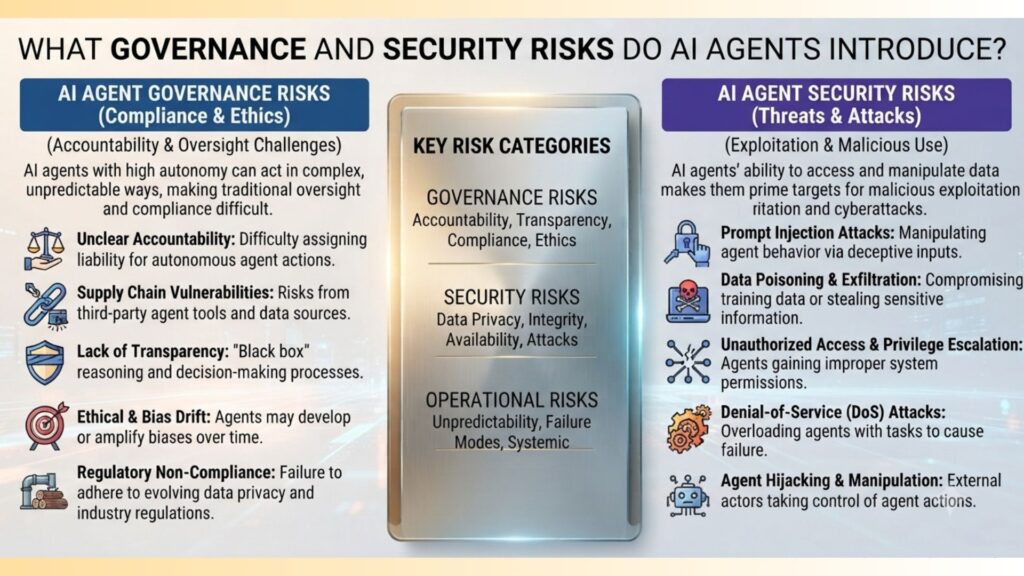
What Governance and Security Risks do AI Agents introduce?
Agentic AI introduces security and governance risks that traditional IT controls were not designed to handle, including privilege drift, prompt injection, unauthorized data access, and what researchers call ‘agent sprawl,’ where many agents operate across systems with no central inventory or named owner.
Eighty percent of companies already report their AI agents have taken unintended actions, including accessing systems without authorization or sharing sensitive data without approval. On the regulatory front, EU AI Act enforcement is set to intensify from August 2026 onward, with substantial penalties for failures of governance in high-risk AI applications involving personal data or financial operations. NIST’s AI Agent Standards Initiative, launched in February 2026, specifically highlights agent identity and authorization as foundational governance pillars. Best practice responses include assigning every agent a unique identity and a named human owner, enforcing least privilege access at every tool connection, and maintaining a detailed audit trail covering not just what an agent did, but why and under what policy conditions. Source: AINews
How should an organization get started with AI Agents?
The safest and most effective approach is to begin with a single, narrow, high-volume workflow where success is easy to measure, then prove the ROI before scaling. Organizations that start with governance built in consistently outperform those that retrofit controls after deployment.
Banking and insurance lead production adoption in 2026 precisely because fraud triage and loan processing offer the profile agents perform best in: well-defined rules, measurable resolution rates, and a clear human escalation path for edge cases. For any first deployment, teams should set explicit autonomy thresholds, which decisions the agent owns, which it escalates before writing a single line of code. Scaling only after a monitored pilot has validated the payback case dramatically reduces the risk of joining the 40 percent of projects forecast to be canceled.
Step by Step
- Identify a high volume, well defined workflow where clear inputs and outputs make success easy to measure.
- Define explicit boundaries for the agent: which actions it can take autonomously and which require a human decision.
- Integrate the agent with the tools and data sources it needs, applying least privilege access at every connection point.
- Register every deployed agent in a central inventory with a named owner, documented permissions, and an audit log.
- Run a monitored pilot, track before-and-after metrics, and only scale once the payback case is proven.
- Establish a continuous governance review cycle to catch privilege drift, unexpected behavior, and evolving compliance requirements.
FAQ: AI Agents and Agentic AI
What is the difference between an AI agent and a chatbot?
A chatbot responds to prompts one turn at a time and has no ability to take action in the world. An AI agent can plan sequences of steps, invoke external tools, make decisions between steps, and pursue a goal autonomously across an entire workflow, not just a single exchange.
Is agentic AI the same as automation or RPA?
No. Traditional robotic process automation follows fixed, rule-based scripts and breaks when it encounters exceptions. Agentic AI can reason through novel situations, adapt its approach mid-task, and handle unstructured data, making it far more flexible than rule based automation, though it requires more rigorous governance.
How much does it cost to deploy an AI agent?
Costs vary enormously based on the model used, tool integrations, and scale of deployment. However, 2026 survey data shows that 74 percent of enterprises reach positive ROI within the first year, with cost reductions of 25 to 40 percent in targeted processes achievable within the first 90 days of a well scoped deployment.
Do AI agents require constant human supervision?
Not constant supervision, but deliberate governance. Best practice in 2026 is to define clear autonomy thresholds, actions the agent handles independently versus actions that require human approval, and to maintain full audit logs. Removing all human oversight entirely is the scenario most strongly correlated with project failure and security incidents.
Conclusion
AI agents and agentic AI represent a genuine step change in how software can contribute to business operations not just answering questions, but completing work. The market data and production case studies from 2026 confirm real returns are achievable, but the organizations capturing them are the ones that treat governance as a prerequisite rather than an afterthought.
Start with a narrow, measurable workflow, build oversight in from day one, and scale only what you can prove that discipline is what separates the 23 percent successfully running agents in production from the majority still stuck in pilot mode.